
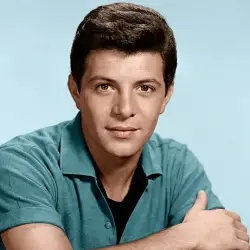
About Frankie Avalon
Frankie Avalon was one of the biggest teen idols of the late 1950s and early 1960s, known for his smooth voice, clean-cut image, and string of hit pop singles that helped define the era before the British Invasion. Born Francis Thomas Avallone in Philadelphia, Pennsylvania, Avalon first gained attention as a talented trumpet player before transitioning into singing and acting.
By the end of the 1950s, Frankie Avalon had become one of America’s most successful young stars, combining chart-topping music with a rapidly growing Hollywood career. His popularity helped establish the “teen idol” phenomenon that dominated pop culture in the years before bands like The Beatles transformed popular music.
With hits like “Venus” and “Why”, Avalon became one of the defining voices of early rock-era pop music.
Frankie Avalon Number One Songs
- Venus (1959)
- Why
Why Frankie Avalon Mattered in the 1960s
Frankie Avalon mattered because he represented the peak of the teen idol era just before rock music changed dramatically in the 1960s. His polished image, romantic ballads, and emotionally direct songs appealed strongly to teenage audiences and helped define mainstream pop music at the end of the 1950s.
His hit “Venus” became one of the biggest songs of 1959, while “Why” achieved a unique place in music history as both the final #1 song of the 1950s and the first #1 song of the 1960s.
Avalon also became one of the first major pop stars to successfully transition into Hollywood films. During the 1960s, he appeared in numerous movies including the hugely popular “Beach Party” films alongside Annette Funicello, helping define American beach culture in pop entertainment.
Unlike many teen idols of the era, Frankie Avalon maintained a successful entertainment career for decades, later introducing himself to a new generation through his role as Teen Angel in the hit 1978 film Grease.
Frankie Avalon and the Billboard Hot 100
Frankie Avalon enjoyed an extraordinary chart run between 1958 and 1962, placing 31 singles on the Billboard charts.
His breakthrough smash “Venus” reached #1 on the Billboard Hot 100 in 1959 and remained there for five consecutive weeks. Billboard later ranked it as one of the biggest songs of the entire year.
Later that same year, Avalon scored another #1 hit with “Why,” which became historically significant as the final #1 single of the 1950s and simultaneously the first #1 hit of the 1960s.
Other major hits included “Just Ask Your Heart,” “Bobby Sox to Stockings,” “A Boy Without a Girl,” and “I’ll Wait for You.”
Although his chart dominance faded as the British Invasion arrived, Avalon successfully reinvented himself through films and television, allowing him to remain a recognizable cultural figure long after many other teen idols disappeared from the spotlight.
Frankie Avalon’s Musical Style
Frankie Avalon blended pop, early rock and roll, orchestral balladry, and traditional vocal pop into a smooth and highly polished sound. His recordings often featured romantic lyrics, lush arrangements, and clean vocal delivery designed to appeal to teenage audiences.
Unlike many rock singers of the period, Avalon’s music emphasized melody and emotional sincerity more than rebellion or rhythm and blues influences. This helped make him especially popular with mainstream pop audiences and television viewers.
He also maintained strong musical skills as a trumpet player throughout his career, a talent that helped distinguish him from many other teen idols.
Later in his career, Avalon even adapted to changing musical trends by recording a disco version of “Venus” in 1976, showing his willingness to evolve with popular music.
Frankie Avalon’s Lasting Legacy
Frankie Avalon remains one of the defining symbols of the teen idol era. His success helped shape pop music, teen culture, and Hollywood entertainment during the transition from the 1950s into the 1960s.
His signature songs “Venus” and “Why” continue to appear in films, television shows, nostalgic retrospectives, and oldies radio programming decades after their original release.
Beyond music, Avalon became one of the few teen idols to build a lasting multi-decade entertainment career through film, television, touring, and live performances.
For fans of 1960s music, Frankie Avalon represents romance, nostalgia, and the final golden years of pre-Beatles American pop—a performer whose music captured the innocence and optimism of an earlier era of rock and roll.