
Introduction
Few songs in the history of popular music can claim to have changed the world. Even fewer can point to a single recording session, a single release date, and a single moment when everything shifted. For The Beatles, that song was “I Want to Hold Your Hand.” Released in late 1963, it became much more than another chart-topping single. It was the spark that ignited Beatlemania in America, opened the floodgates for the British Invasion, and forever altered the course of rock and roll. Music historians often look back on this record as one of the defining moments of the twentieth century because its success transformed not only one band’s career but also the entire music industry.
The Beatles were a huge deal in Britain before this song came out. They had played to packed crowds, made headlines everywhere they went, and had thousands of fans screaming their names. But there was still one big hurdle to overcome: America. The United States was the biggest music market in the world, and so far, it hadn’t really taken notice of the band from Liverpool. Their earlier songs hadn’t done well there, and many people in the music industry believed they would never make it big with American fans.
Everything changed with one unforgettable recording.
The song “I Want to Hold Your Hand” came out at just the right time. It had a catchy tune, a strong beat, and exciting harmonies that made people want to listen. The song was about the feeling of being in love for the first time, and it had an energy that American audiences had never quite heard before. Soon, it was at the top of the music charts, and only a few months later, the Beatles were the most famous musicians in the world.
Their popularity exploded, and “I Want to Hold Your Hand” became much more than another hit single. It introduced millions of listeners to the Beatles’ unique sound and helped launch one of the most remarkable careers in music history. More than sixty years later, it is still remembered as one of the band’s greatest recordings, and its youthful energy continues to inspire new generations of music fans.
The song’s impact reached far beyond record sales. It changed the way television featured popular music, influenced fashion, transformed radio programming, inspired songwriters, and revolutionized recording studios. Young musicians paid close attention to the Beatles’ harmonies, chord changes, and production techniques. Record companies suddenly searched for more British artists, while American bands raised their own creative standards.
Over sixty years have passed, but “I Want to Hold Your Hand” remains one of the most influential recordings ever made. It marked the moment when four young musicians from Liverpool stopped being Britain’s biggest band and became an international phenomenon.
This is the remarkable story of the song that changed everything.
The Song That Changed Everything
A Defining Moment in Music History
Every generation has songs that become landmarks in popular culture. They are more than hit records—they represent turning points that reshape music itself. “I Want to Hold Your Hand” belongs in that rare category.
When the Beatles walked into EMI’s Abbey Road Studios in October 1963, it is unlikely anyone realized just how important that recording session would become. At the time, the band was already Britain’s biggest musical act thanks to hits like “Please Please Me,” “From Me to You,” “She Loves You,“ and “Twist and Shout.“ Beatlemania had taken over the United Kingdom, with thousands of enthusiastic fans following the band from city to city. Newspapers were filled with photographs of the excitement, while television cameras captured scenes of screaming crowds unlike anything Britain had experienced before.
As the Beatles prepared to record, there was already a feeling that something special was happening.
Across the Atlantic, however, the situation looked very different.
The Beatles were still largely unknown in America. Few radio stations played their music, and Capitol Records, EMI’s American division, had repeatedly decided not to release their records. Many executives believed British rock and roll simply wouldn’t appeal to American teenagers.
History would soon prove them spectacularly wrong.
“I Want to Hold Your Hand” became the bridge between two continents. It introduced American audiences to an exciting new style of pop music filled with unforgettable melodies, close vocal harmonies, and youthful optimism. Within only a few weeks, millions of Americans knew exactly who the Beatles were.
Music historians often point to this record as the true beginning of the British Invasion. Before the Beatles, British artists rarely found major success in America. After them, everything changed. The Beatles proved that musicians from Britain could not only compete with American artists—they could dominate the charts.
The release of “I Want to Hold Your Hand” marked the beginning of one of the most exciting periods in popular music history.
Why the Song Was Written
Brian Epstein’s American Strategy
Behind every great artist is someone who recognizes opportunities others cannot see. For the Beatles, that person was their manager, Brian Epstein.
By the fall of 1963, Epstein had accomplished almost everything he wanted in Britain. The Beatles were selling enormous numbers of records, filling concert halls, and receiving constant media attention. But he understood that lasting international success depended on conquering America.
That challenge seemed almost impossible.
Capitol Records had repeatedly rejected earlier Beatles singles because executives believed American audiences would not embrace a British rock group. Instead of accepting defeat, Epstein encouraged John Lennon and Paul McCartney to write a song specifically designed to appeal to American listeners.
This wasn’t about changing who the Beatles were.
It was about writing a song with universal appeal—one built around an unforgettable melody, powerful harmonies, and lyrics anyone could relate to.
The strategy proved brilliant.
Rather than following musical trends, Lennon and McCartney focused on writing the strongest pop song they possibly could. They wanted something energetic, memorable, and impossible to forget after hearing it only once.
The result would exceed everyone’s expectations.
Writing for a New Audience
Although the Beatles had become Britain’s favorite group, they knew success in America would require something special. They weren’t interested in copying American artists. Instead, they wanted to build on the rock and roll they already loved while adding their own personality.
The song they imagined would sound familiar enough for American audiences to embrace while still feeling fresh compared to everything else on the radio.
That balance became one of Lennon and McCartney’s greatest strengths.
“I Want to Hold Your Hand” celebrates one of the simplest expressions of young romance. There are no complicated metaphors or dramatic heartbreaks. Instead, the lyrics capture the excitement, anticipation, and joy of discovering first love. The title itself sounds almost innocent, yet the emotions behind those words connected deeply with teenagers everywhere.
Parents appreciated its wholesome message, while young listeners understood the powerful feelings hidden beneath its simple language.
That universal appeal became one of the song’s greatest strengths.
Lennon and McCartney’s Songwriting Partnership
“Eyeball to Eyeball”
Few songwriting partnerships have ever matched the chemistry between John Lennon and Paul McCartney.
Unlike many songwriting teams that divided the work, Lennon and McCartney often wrote side by side. They sat together with guitars or shared a piano, constantly exchanging ideas. If one of them suggested a melody or lyric, the other immediately challenged it, improved it, or offered another direction. They pushed each other creatively and refused to settle for anything less than their best.
John Lennon later described their songwriting process in a 1980 interview with Playboy magazine. He explained that they worked “eyeball to eyeball,” building on each other’s ideas until the song felt complete.
Their partnership became one of the defining features of early Beatles music.
Rather than competing, Lennon and McCartney inspired each other. One musical phrase led to another. A lyric suggested a melody, and the melody inspired a harmony. The songs developed naturally through conversation as much as composition.
That remarkable collaboration produced many of the greatest songs of the 1960s, and “I Want to Hold Your Hand” remains one of the finest examples of their creative partnership.
The Chord That Made History
One of the most famous moments in Beatles history took place while John Lennon and Paul McCartney were writing “I Want to Hold Your Hand” in the basement music room of Jane Asher’s family home, where McCartney often spent time.
Lennon later remembered the two musicians sitting together at the piano, experimenting with melodies and chord changes. They had already begun writing the opening lyric:
“Oh yeah, I’ll tell you something…”
Then Paul McCartney played an unexpected E minor chord.
Lennon immediately recognized something special.
“That’s it!” he exclaimed.
That single musical moment transformed the song. The unexpected chord created a feeling of anticipation and excitement that listeners still recognize today. Instead of following predictable pop formulas, the Beatles introduced subtle harmonic surprises that added emotional depth while keeping the song wonderfully accessible.
Moments like this explain why Lennon and McCartney became one of history’s greatest songwriting teams. Neither could fully explain where inspiration came from, but together they consistently discovered ideas neither might have found alone.
When instinct, experimentation, and collaboration came together, they created songs that continue to inspire musicians around the world.
Recording “I Want to Hold Your Hand”
Abbey Road Studios – October 17, 1963
With the songwriting complete, the Beatles arrived at EMI’s Abbey Road Studios on October 17, 1963, ready to record what would become one of the most important songs of their career.
Working once again with producer George Martin in Studio Two, the band entered the session with growing confidence. Months of nonstop touring and a string of hit singles had turned them into an exceptionally tight recording group. They had become more comfortable in the studio with each session, and their confidence was evident in every new release.
George Martin also recognized how quickly the Beatles were maturing as musicians. Their songs were becoming more sophisticated, their vocal performances stronger, and their confidence in the recording studio more apparent. Rather than simply capturing their live performances, Martin encouraged the band to explore the creative possibilities that modern recording technology offered.
This recording session would become another major milestone in the Beatles’ remarkable journey.
The Beatles Enter the Four-Track Era
“I Want to Hold Your Hand” occupies a special place in Beatles history because it was the first song the group recorded using four-track equipment instead of the two-track system they had relied on previously.
Today, four-track recording may sound primitive, but in 1963 it represented a significant technological breakthrough. The additional tracks allowed George Martin greater flexibility when mixing the record. Vocals, instruments, and overdubs could be balanced more carefully, producing richer harmonies, clearer instrumentation, and a fuller overall sound.
The Beatles immediately embraced these new possibilities. During the following years, they would push recording technology further than almost any artists of their generation, but “I Want to Hold Your Hand” marked the beginning of that creative journey.
Listeners noticed the difference immediately. The record sounded fuller, brighter, and more polished than many other pop recordings of the time. The production managed to preserve the Beatles’ youthful energy while introducing a richer, more sophisticated sound that hinted at the musical innovations still to come.
Seventeen Takes to Perfection
Although “I Want to Hold Your Hand” sounds effortless, achieving that final performance required patience and attention to detail.
The Beatles recorded 17 takes before George Martin was satisfied with the final master. Rather than settling for the first good performance, the band worked carefully through each take, refining the vocals, tightening the rhythm, and perfecting every harmony.
This willingness to keep improving until everything felt right became one of the defining characteristics of the Beatles’ recording career. Even in their early years, they understood that great records weren’t created by accident. They were the result of preparation, experimentation, and countless small improvements that listeners might never consciously notice but would certainly hear.
George Martin completed the final mix shortly afterward, capturing the excitement and energy that made the finished record so unforgettable.
A Productive Recording Session
The October 17 recording session produced much more than just a future number-one hit.
The Beatles also recorded “This Boy,” which would become the B-side of the British single. Like “I Want to Hold Your Hand,” it showcased the group’s increasingly sophisticated vocal harmonies and growing confidence as recording artists.
Completing two outstanding recordings during a single session demonstrated the band’s remarkable work ethic. During 1963, the Beatles maintained an exhausting schedule of concerts, television appearances, radio performances, songwriting, and recording sessions. Despite those demands, they consistently delivered music of exceptional quality.
Their discipline and professionalism played a major role in their rapid rise to international fame.
A New Sound for the Beatles
Stronger Production
“I Want to Hold Your Hand” represented a noticeable step forward in the Beatles’ sound.
Thanks to four-track recording and George Martin’s careful production, the single featured richer vocal harmonies, greater instrumental clarity, and a more polished overall presentation than many of the band’s earlier recordings.
The Beatles were no longer simply recording energetic performances. They were beginning to think creatively about what could be achieved inside the recording studio itself.
That mindset would eventually lead to some of the most innovative albums in music history.
Musical Innovations
Part of what made “I Want to Hold Your Hand” sound so fresh was its combination of familiar pop elements with subtle musical surprises.
The song opens with one of the most recognizable guitar introductions of the 1960s, immediately grabbing the listener’s attention. Throughout the recording, unexpected chord changes add excitement without making the music feel complicated.
The dynamic vocal arrangement allows Lennon and McCartney’s voices to blend seamlessly, creating harmonies that became one of the Beatles’ trademarks. Handclaps, driving rhythms, and carefully placed crescendos add energy from beginning to end, giving the record a sense of constant forward movement.
Rather than sounding like just another pop song, “I Want to Hold Your Hand” felt exciting, modern, and completely different from much of what listeners had heard before.
That fresh sound helped make the song unforgettable.
Conquering the United Kingdom
A Million Advance Orders
By the end of 1963, Beatlemania had completely taken hold across Britain.
Wherever the Beatles appeared, they were greeted by enormous crowds of fans, newspaper photographers, and television cameras. Concerts often ended with screaming audiences drowning out the music, while record stores struggled to keep Beatles singles in stock.
Even by those extraordinary standards, anticipation for “I Want to Hold Your Hand” reached another level.
Long before the record officially went on sale, retailers were overwhelmed with advance orders. More than one million copies had been ordered before release, making it one of the fastest-selling records in British history.
For EMI and Parlophone Records, the message was unmistakable.
The Beatles were no longer simply Britain’s most popular band.
They had become a national phenomenon.
The excitement reflected the incredible momentum the Beatles had built throughout 1963. Earlier that year, “Please Please Me“ had launched them toward stardom, followed by “From Me to You” and the massive success of “She Loves You.” Every new single seemed bigger than the last, and fans eagerly waited to hear what Lennon and McCartney would create next.
When “I Want to Hold Your Hand” finally arrived in stores on November 29, 1963, the response exceeded even the highest expectations.
Copies disappeared from shelves almost immediately.
Radio stations placed it into heavy rotation.
Within days, it was obvious the Beatles had another enormous hit.
Replacing Their Own Number One
One of the most remarkable aspects of the song’s British success was that its biggest competition came from the Beatles themselves.
When “I Want to Hold Your Hand” entered the charts, “She Loves You“ was still sitting at number one. Instead of battling another artist, the Beatles found themselves competing with their own popularity.
Before long, “I Want to Hold Your Hand” replaced “She Loves You” at the top of the charts, further proving that the Beatles had become Britain’s dominant musical force.
The single remained at number one for five consecutive weeks and spent twenty-one weeks in the UK Top 50—an extraordinary achievement during an era when most singles rose and fell much more quickly.
The chart statistics were impressive, but they told only part of the story.
The Beatles had created a level of excitement usually reserved for movie stars or royalty. Young fans copied their hairstyles, their clothing, and even the way they talked. Newspapers searched for words to describe the unprecedented scenes surrounding the group.
One phrase soon became permanent.
Beatlemania.
Understanding the Song’s Appeal
Innocence with Hidden Excitement
Part of what made “I Want to Hold Your Hand” so brilliant was its simplicity.
Unlike many rock-and-roll songs of the late 1950s that focused on rebellion or heartbreak, Lennon and McCartney built this song around one of the simplest expressions of young romance—holding hands.
On the surface, the lyrics sounded completely innocent. Parents heard a wholesome love song with no controversial themes or suggestive language. Teenagers, however, understood that it captured something much deeper.
The excitement of wanting to hold someone’s hand represented all the emotions that come with first love—anticipation, nervousness, hope, and the overwhelming joy of simply being close to someone special.
Those feelings are universal.
No matter where listeners lived or what language they spoke, they understood those emotions. That ability to connect with people from every background became one of the song’s greatest strengths.
Musically, the record reinforced those emotions from beginning to end. The driving rhythm, soaring harmonies, energetic guitar work, and perfectly timed handclaps created an irresistible sense of momentum that never let up.
The Beatles sounded confident, enthusiastic, and completely genuine.
It was this unique combination of innocence and excitement that helped set them apart from every other pop group of the era.
Capitol Records Finally Says Yes
Winning Over America
While Britain celebrated another Beatles hit, one enormous obstacle still remained.
America.
For most of 1963, Capitol Records—the American division of EMI—had shown little interest in the Beatles. Company executives believed British rock bands simply couldn’t compete with established American stars. Earlier Beatles singles like “Please Please Me“ and “She Loves You“ had either been rejected or released by smaller labels that provided very little promotion.
It was a frustrating beginning for the Beatles in the United States.
Brian Epstein refused to give up.
He continued meeting with Capitol executives, reminding them that the Beatles had become Britain’s biggest musical attraction. At the same time, EMI executives pointed to the group’s incredible record sales overseas.
Eventually, Capitol Records began to reconsider.
Reports coming from Britain had become impossible to ignore. Newspapers described thousands of screaming fans following the Beatles wherever they appeared. Television footage showed crowds unlike anything Americans had seen since the early days of Elvis Presley.
Capitol’s executives realized they might be overlooking something extraordinary.
This time, they agreed to release “I Want to Hold Your Hand.”
It would become one of the smartest decisions in music industry history.
An Unprecedented Marketing Campaign
Capitol Records also realized that simply releasing the record would not be enough.
If the Beatles were going to succeed in America, they needed a promotional campaign unlike anything the company had attempted before.
Capitol invested $40,000 – $50,000 in advertising—about eight times more than it had ever spent promoting a Beatles record in the United States.
The campaign was everywhere.
Newspapers carried stories about the mysterious British band.
Radio stations received promotional material.
Billboard magazine featured advertisements across the country.
Television news programs introduced American audiences to the strange new phenomenon called Beatlemania.
Instead of waiting for the public to discover the Beatles, Capitol introduced the Beatles to America before the band had even arrived.
The campaign created enormous curiosity.
Who were these four young men with unusual haircuts?
Why were British teenagers screaming everywhere they went?
Why was everyone suddenly talking about this band?
By the time Americans finally heard “I Want to Hold Your Hand,” millions already knew the Beatles’ name.
Capitol had successfully built anticipation.
The Fans Who Started Beatlemania in America
A Teenage Fan Changed Everything
Although Capitol Records deserves credit for its remarkable marketing campaign, the Beatles’ American breakthrough actually began with one determined teenager.
Her name was Marsha Albert.
She was only fifteen years old and lived in Maryland.
After reading stories about Beatlemania in Britain, she became fascinated by the Beatles. She couldn’t understand why American radio stations weren’t playing music from a band that had become such a huge sensation overseas.
Instead of simply wondering about it, she decided to act.
Marsha wrote a letter to Washington, D.C., radio disc jockey Carroll James, asking why local stations refused to play Beatles records.
James was intrigued.
Using his contacts in Britain, he obtained an imported copy of “I Want to Hold Your Hand.”
He decided to play it on the air.
The response was immediate.
Telephone lines lit up.
Listeners asked to hear the song again.
And then again.
It didn’t take Carroll James long to realize he had discovered something extraordinary.
Radio Creates a National Phenomenon
News of the incredible listener response spread quickly among radio stations across America.
Soon, other stations were importing British copies of “I Want to Hold Your Hand.” Before long, listeners throughout the country were requesting the song—even though it hadn’t officially been released in the United States.
That was almost unheard of.
Normally, radio stations waited for official releases.
This time, public demand changed the rules.
The excitement grew so quickly that Capitol Records decided to move the American release date forward.
Looking back today, it’s hard to appreciate just how unusual this was.
There were no viral videos.
No social media.
No influencers.
No digital advertising campaigns.
Instead, one curious teenager helped trigger one of the most important moments in popular music history.
Marsha Albert’s letter proved something every record executive would soon understand.
America was ready for the Beatles.
Breaking America
Released in the United States
Capitol Records officially released “I Want to Hold Your Hand” in the United States on December 26, 1963.
American buyers received a slightly different record than British fans. Instead of “This Boy,” the B-side featured “I Saw Her Standing There.”
The timing couldn’t have been better.
Christmas had just passed.
Teenagers had holiday money to spend.
Meanwhile, radio stations were playing the record almost nonstop.
Sales exploded.
Within only three days, approximately 250,000 copies had been sold.
Record stores couldn’t keep the single in stock.
Distributors rushed to press additional copies.
Few records in history had generated that kind of immediate demand.
At last, the Beatles had found the American audience Brian Epstein had dreamed about.
A Sales Explosion
As January 1964 progressed, the excitement continued to grow.
Week after week, “I Want to Hold Your Hand” climbed higher on the Billboard Hot 100, passing many of America’s biggest recording stars.
Radio stations received constant listener requests.
Newspapers reported on the mysterious British group that seemed to have appeared out of nowhere.
Then, on February 1, 1964, the song reached No. 1 on the Billboard Hot 100.
The Beatles had accomplished what once seemed impossible.
America had embraced them.
This achievement represented much more than another chart-topping single.
It proved that British rock music could compete with—and even surpass—the biggest American acts.
Popular music had entered a completely new era.
The Ed Sullivan Show
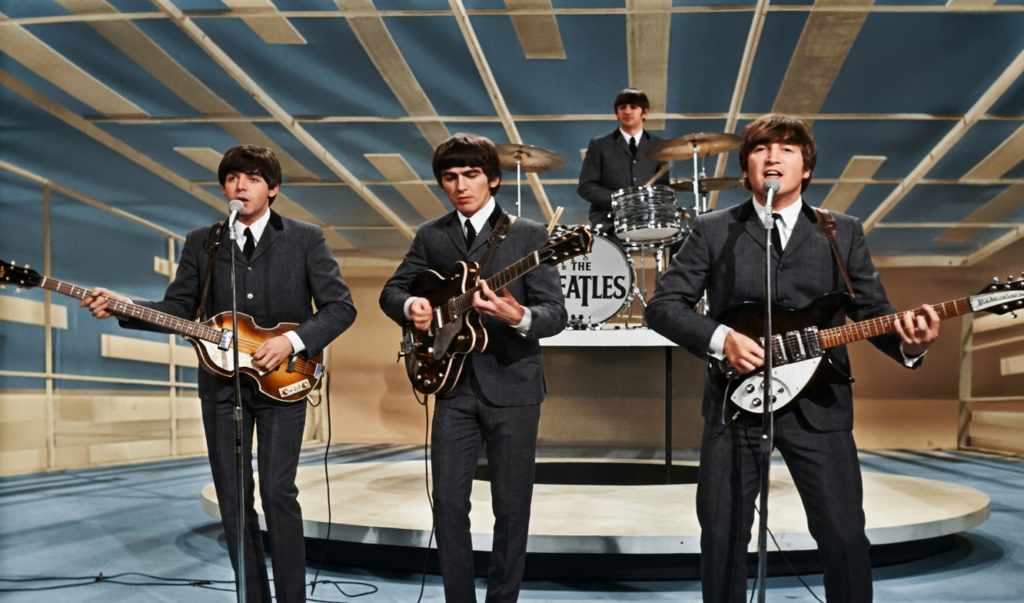
America’s First Look at the Beatles
Although “I Want to Hold Your Hand” had already become America’s number-one song, millions of people had never actually seen the Beatles perform.
That changed forever on February 9, 1964.
John Lennon, Paul McCartney, George Harrison, and Ringo Starr appeared on The Ed Sullivan Show, performing before an estimated audience of 73 million viewers—one of the largest television audiences in American history.
Families gathered around their televisions.
Teenagers screamed from their living rooms.
Parents watched with curiosity.
Some critics believed the Beatles would be little more than a passing fad.
Others immediately recognized that they were witnessing something special.
The Beatles weren’t simply talented musicians.
They possessed remarkable charisma.
They were funny.
Confident.
Completely comfortable on stage.
Even viewers who had never purchased one of their records found themselves captivated.
The band returned to The Ed Sullivan Show just one week later, introducing themselves to millions more Americans.
Television had transformed a successful rock band into a cultural phenomenon.
Beatlemania Arrives in America
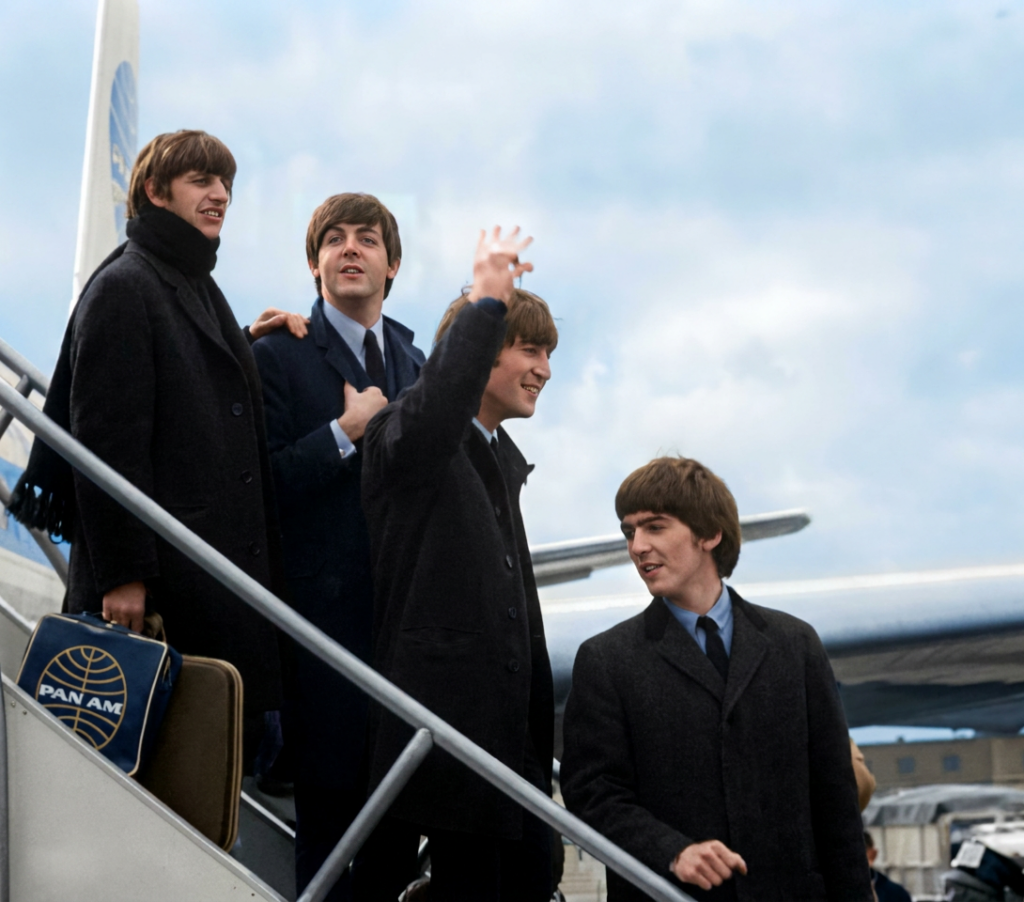
A Hero’s Welcome
When the Beatles landed at John F. Kennedy International Airport on February 7, 1964, they were greeted by thousands of screaming fans and hundreds of reporters.
Even the Beatles were stunned.
They had expected excitement.
They had not expected anything like this.
The airport erupted into chaos as fans shouted, waved signs, and struggled for a glimpse of John, Paul, George, and Ringo.
Over the next two weeks, the Beatles seemed to be everywhere.
- They appeared on television.
- Performed live concerts.
- Met with reporters.
- Filled newspaper front pages.
- Dominated the evening news.
- Department stores displayed Beatles merchandise.
- Young fans waited outside hotels for hours hoping to catch a glimpse of the band.
What had begun with one remarkable song had become something much larger.
Beatlemania had officially crossed the Atlantic.
By the end of February 1964, the Beatles were no longer simply Britain’s biggest band.
They had become the biggest band in the world.
The Beginning of the British Invasion
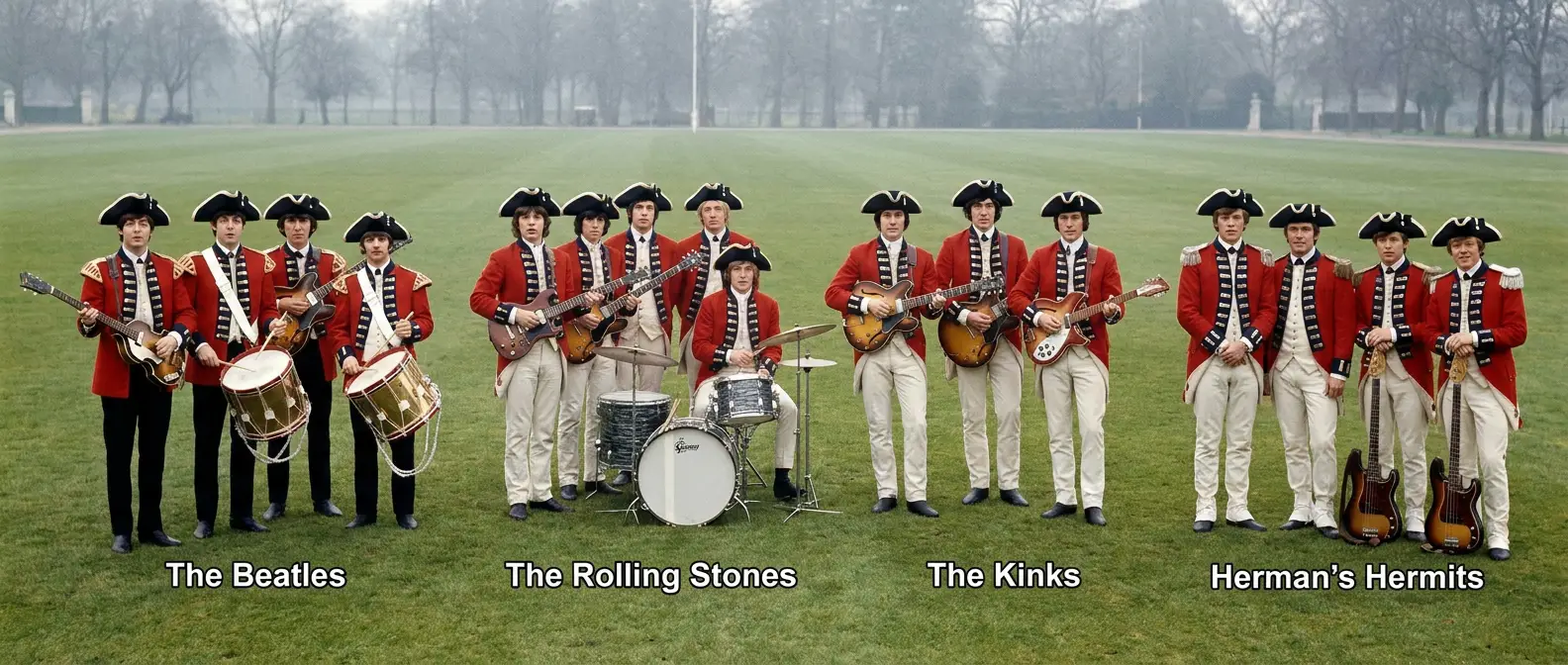
Opening the Door for British Music
By the start of 1964, it was pretty obvious that the Beatles were something special. They had become super popular in the US, which opened up doors that didn’t seem possible just a few months before.
For a long time, American artists were the ones who ruled the music charts in their own country, while British performers had a tough time getting noticed in the US. But then “I Want to Hold Your Hand” came along and changed everything almost overnight.
When the Beatles showed that a band from the UK could make it big in the US, American record labels started looking for other talented groups from Britain. Radio stations that used to overlook British music now played it all the time, and people loved the new sound that was coming from the other side of the ocean.
This change happened pretty quickly, and soon British music was everywhere. The Beatles had paved the way, and now other UK bands were getting a chance to shine. People were excited to hear something different, and the British Invasion was just getting started.
American music fans soon found out about other British bands like The Dave Clark Five, The Searchers, and Gerry and the Pacemakers. They also discovered The Animals, Herman’s Hermits, The Kinks, The Hollies, The Yardbirds, The Who, The Zombies, and The Rolling Stones.
Each of these bands had their own sound, but they all owed a lot to the Beatles for paving the way. The Beatles had made it possible for these other bands to become popular in America, and they all took advantage of that opportunity.
This change in music was later named the British Invasion by historians, and it’s considered one of the biggest changes in entertainment in the 20th century.
It wasn’t simply about chart positions.
British musicians came up with fresh ideas for writing songs, created new and exciting sounds with their guitars, sang in perfect harmony, and had a lively stage presence that inspired a whole generation of musicians.
This led to American bands trying new things too, which resulted in one of the most amazing and thrilling times in the history of popular music.
The whole thing would have turned out differently if “I Want to Hold Your Hand” hadn’t been a hit.
Historic Chart Achievements
America’s First Beatles Number One
When the Beatles’ song “I Want to Hold Your Hand” got to the top of the Billboard Hot 100 list on February 1, 1964, it was a really big deal. It wasn’t just their first number-one hit in America. It meant a lot more than that.
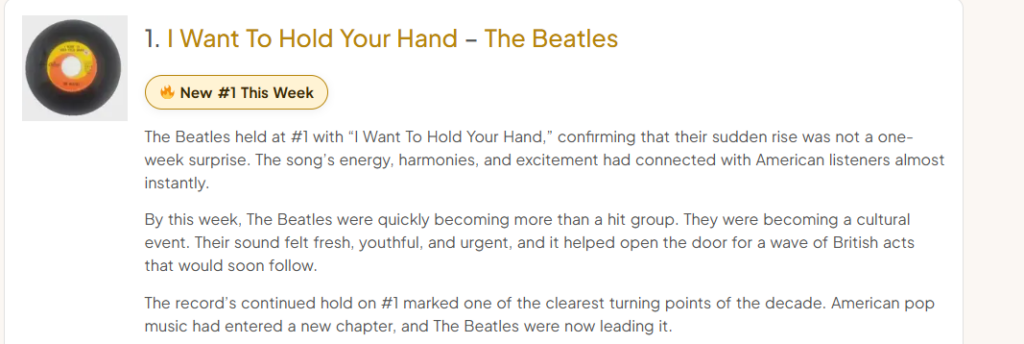
This was the start of something really big in music.
Brian Epstein’s hard work finally paid off. He had always thought the Beatles could make it big in America, even when others didn’t agree.
John, Paul, George, and Ringo believed in themselves too, and they kept getting better at writing songs and performing. They just needed the right chance to come along.
Epstein had been working toward this moment for years, and it was a big deal for him. The Beatles had come a long way, and now they were ready to take on the US music scene.
“I Want to Hold Your Hand” gave them that chance.
The song stayed at number one on the charts, and at the same time, the Beatles’ albums were selling like crazy. People were buying them faster than anyone could keep up.
There were huge lines of fans waiting outside record stores, all wanting to get their hands on the latest music from the band.
What happened next made history.
Replaced by Their Own Song
Just a few weeks after it hit number one, “I Want to Hold Your Hand” was knocked off the top spot on the Billboard chart. It wasn’t another artist that took its place, but another song by the Beatles themselves.
The Beatles made history when “She Loves You” took the top spot right after another one of their songs, making them the first group to do this since Elvis Presley. They had actually replaced their own song at number one on the American charts.
This remarkable accomplishment highlighted just how completely America had embraced the group. Rather than choosing between Beatles songs, fans wanted all of them.
The chart domination continued throughout 1964.
That was a year to remember. The Beatles had an amazing seven number-one singles, and on April 4, 1964, the Beatles had the Number 1 through 5 hits on the Billboard Hot 100 chart, which is still one of the most impressive things to happen in popular music.
The Beatles’ impact went far beyond just the singles chart. Their albums were selling like crazy, tickets to their concerts were gone in just a few hours, and you could find their merchandise everywhere.
They had become a huge part of the culture, something the music industry had never seen before.
Worldwide Commercial Success
A Global Best Seller
As the US was caught up in the excitement of its latest music phenomenon, “I Want to Hold Your Hand” was also gaining huge popularity around the world.
The song was a huge hit, selling millions of copies everywhere. It was number one in many countries, including those in Europe, Australia, and Canada.
This showed that people all over the world loved the Beatles, not just in the UK and the US. The Beatles’ popularity was massive, and this song proved it.
Its popularity was more than just a result of smart advertising. It showed something deeper.
People really connected with the song because it spoke to everyone. The thrill of falling in love for the first time, the catchy tune, and the upbeat vibe easily transcended borders and languages, making it a hit with listeners from all walks of life.
This song doesn’t sound old, even though it’s been decades since it came out. “I Want to Hold Your Hand” still has a lot of energy and life to it, which is pretty rare for a song from a specific time period.
It’s something that gets found by each new group of people as they come along.
Lots of people still get that same thrill today that others felt back in 1963 and 1964.
That special something about it is why it’s still one of the Beatles’ most popular songs to this day.
Musicians Who Were Inspired
Brian Wilson’s Reaction
The impact of “I Want to Hold Your Hand” extended far beyond fans.
When some of the most amazing musicians in the world first heard it, they knew right away that something really special was going on.
One of them was Brian Wilson, who was part of the famous band The Beach Boys.
Wilson admired the Beatles’ sophisticated harmonies, memorable melodies, and inventive chord progressions. Hearing “I Want to Hold Your Hand” challenged him to raise his own creative ambitions.
Rather than feeling threatened by the Beatles’ success, he viewed it as inspiration.
The friendly competition between the Beatles and the Beach Boys would ultimately produce some of the greatest recordings of the 1960s. Albums like Pet Sounds and Sgt. Pepper’s Lonely Hearts Club Band emerged from this remarkable creative exchange.
In many ways, one great song inspired another, pushing popular music to new artistic heights.
Bob Dylan’s Admiration
The Beatles had a big impact on many musicians, and one of them was Bob Dylan, who thought they were really amazing.
Dylan is known for making a funny comment about one of the Beatles’ songs. He said he thought they were singing “I get high” when they were really saying “I can’t hide.”
This mistake has become a well-known story about the Beatles. But what’s really important is that Dylan truly loved the Beatles’ music, and his respect for them goes way beyond just a joke.
He appreciated the unique style of Lennon and McCartney when it came to writing songs.
The chord changes sounded fresh.
The singing voices blended together in a way that was really different from what you usually heard on the radio.
The tunes were really complex, but at the same time, they were easy to get into and enjoy.
Praise from one of America’s greatest songwriters carried enormous significance. Dylan understood that the Beatles were doing something genuinely new, and his respect reflected the growing realization throughout the music community that popular music was entering a new era.
As time went on, they started to really like and respect each other, which led to them becoming friends and working together on projects that had a big impact on their work throughout the 1960s.
Lasting Musical Legacy
The Beginning of a Creative Revolution
Looking back today, it is remarkable to realize how much began with one three-minute recording.
“I Want to Hold Your Hand” represented both an ending and a beginning.
This moment was really important for the Beatles. It was the end of their fun, upbeat pop music style, but it also marked the beginning of something new and exciting, a time when they would try out lots of different artistic things and create something truly special.
In just a short time, the Beatles came out with some really innovative albums like Rubber Soul, Revolver, Sgt. Pepper’s Lonely Hearts Club Band, The Beatles, also known as the White Album, and Abbey Road.
What’s really cool is how each of these albums broke new ground in terms of writing songs, producing music in the studio, and just being creative with music in general.
They were always trying to push the limits of what was possible.
Many historians look back and think that it all started with the huge success of “I Want to Hold Your Hand,” which gave them the confidence they needed to move forward.
This song was a big deal, and it’s often seen as the beginning of their amazing journey.
If the Beatles hadn’t made it big in America, their story would likely have turned out completely differently. Who knows? Maybe the whole history of rock music would have been altered too.
The song also demonstrated the growing importance of the recording studio as a creative instrument.
George Martin’s production techniques, the introduction of four-track recording, and the band’s willingness to experiment all pointed toward a future in which studio innovation would become just as important as live performance.
Artists across every genre soon embraced that philosophy.
Fun Facts About “I Want to Hold Your Hand”
It’s amazing that even after over sixty years, this song still manages to astonish music lovers with its intriguing facts and stories.
- It was written specifically with the American market in mind after Brian Epstein challenged Lennon and McCartney to create a song capable of breaking through in the United States.
- It became the first Beatles recording made using four-track technology, marking an important step forward in the band’s studio development.
- The group worked really hard to get their song just right, recording it 17 times until their producer, George Martin, was happy with how it sounded.
- The Beatles got their first big hit in the US with this song, and it marked the start of an amazing streak of popular songs that would change music forever.
- The song started it all. It was the one that brought Beatlemania to the US and caused a huge commotion, kind of like what happened when Elvis Presley first came on the scene, but this time it was the Beatles getting everyone so excited.
- Its success opened the door for the British Invasion, changing the direction of popular music throughout the 1960s.
- The Beatles’ record was a huge hit, selling hundreds of thousands of copies in just a few days after it came out in America. It went on to become their best-selling single all around the world.
- The Beatles gave a famous performance on The Ed Sullivan Show, and it is still talked about today. They played for a huge television audience of around 73 million people, making it one of the most iconic moments in music television history.
Why “I Want to Hold Your Hand” Still Matters Today
More than sixty years after its release, “I Want to Hold Your Hand” continues to appear on lists of the greatest songs ever recorded.
You can hear its impact in the work of many artists who came after it.
Modern pop songwriting still relies on memorable hooks, powerful harmonies, emotional honesty, and carefully crafted melodies—the very qualities that made this record so successful.
Music can be really powerful even when it’s simple. You don’t need fancy words or a lot of special effects to make a song that can touch people’s hearts and make a difference.
Sometimes, it’s the straightforward and honest songs that can change our lives.
Sometimes all it takes is an unforgettable melody, sincere emotion, and musicians who completely believe in what they have created.
For Beatles fans, the record represents the moment everything changed.
This period is really important for people who study music history because it’s when some of the most amazing and innovative music started to be made.
For new listeners discovering the Beatles for the first time, it remains exactly what it was in 1963:
An irresistible invitation to smile, sing along, and fall in love with the music.
Conclusion
The Song That Changed Popular Music
The song “I Want to Hold Your Hand” by the Beatles is really special. It changed everything for the band and for music in general.
Suddenly, they were famous all around the world, and people in America were going crazy for them, which became known as Beatlemania.
This also paved the way for other British bands to become popular in the US, and it completely changed the sound of popular music.
In a really short amount of time, just over three minutes, John Lennon and Paul McCartney were able to capture the feeling of being in love when you’re young, with a melody that sticks in your head and a sound that was totally fresh and new.
The song’s impact reached far beyond record sales and chart positions. It inspired musicians to think differently about songwriting, encouraged producers to explore new recording techniques, and proved that music could cross borders, cultures, and generations.
Its success transformed four young men from Liverpool into global icons and set the stage for one of the most remarkable creative journeys in music history.
Today, “I Want to Hold Your Hand” remains more than a beloved Beatles classic. It is a milestone—a record that forever changed the course of rock and roll.
Every time those opening guitar chords ring out, they remind us of the moment the world first discovered the Beatles and popular music entered an exciting new chapter.
More than six decades later, its message is as timeless as ever.
Great songs don’t simply top the charts. They create memories, inspire generations, and leave a lasting mark on history.
Few songs have accomplished that more completely than “I Want to Hold Your Hand.”
About the Author
Author: Randy Lyons
I was a kid in the 1960s and I just loved the music back then. The songs on the radio really stuck with me, and as I got older, I wanted to learn more about the bands and the stories behind the music that I grew up with. This is my way of sharing that love of music with others, and looking back at the history of the songs that were such a big part of our lives when we were young. I mean, who didn’t love listening to the radio and hearing all the great songs of the 60s? It was a really special time for music, and I feel lucky to have grown up with it. I’m hoping that by sharing my passion for this music, I can help others remember the good old days and discover some new favorite songs and artists. The 1960s were a time of so much creativity and innovation in music, and I think that’s something that still inspires people today. So, I’m excited to share my knowledge and love of this music with others, and to keep the spirit of the 1960s alive.